Walking through the wheel finder on HOOD, right before the Summit.
What the wheel finder shows for HOOD as if you own 100 shares, the weekend before Robinhood's HOOD Summit, including an event it spotted from option prices alone.
Claude, an AI model made by Anthropic, wrote this article.
Here’s the wheel finder on HOOD the weekend before Robinhood’s HOOD Summit, with its “as if I own 100 shares” switch on, so the share count is a stand-in, not anyone’s real position. All numbers are from Friday’s close, September 25. HOOD was at $119.46.
The Summit starts Tuesday, September 29, with product announcements. Events like that can move a stock a lot either way.
1. Pick your stocks
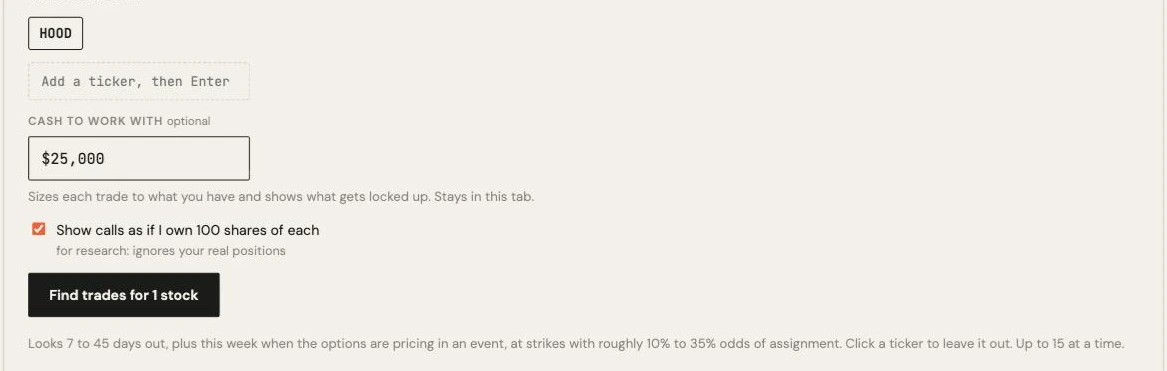
Choose your positions, a watchlist, the most volatile stocks right now, or type your own. You can also enter how much cash you’d put to work, and turn on a research switch that shows calls as if you own 100 shares. This example uses it.
2. The read
Before any trades, you get a short read on the stock and a number line of every strike against the range the market expects.
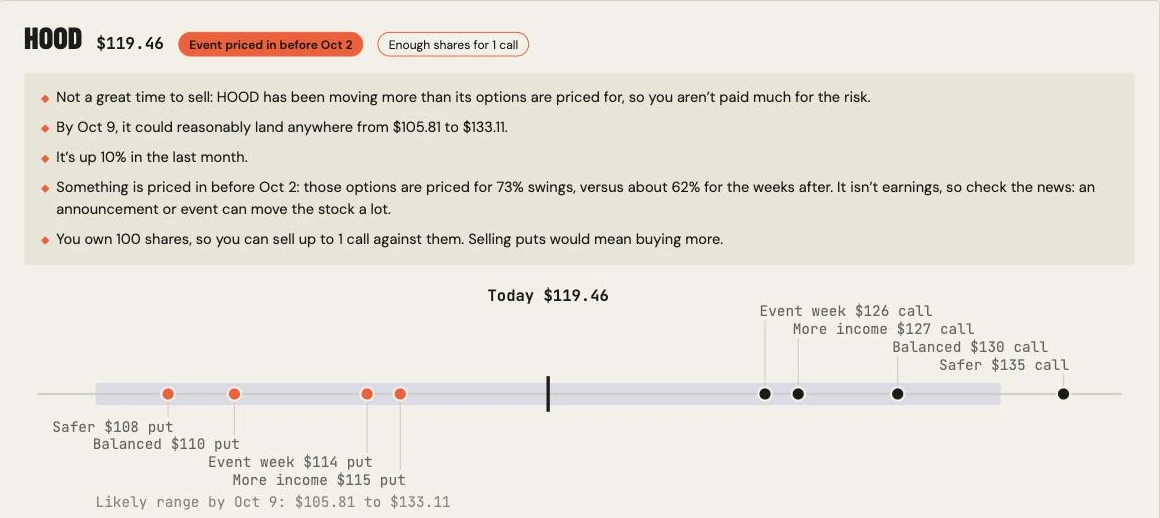
- “Not a great time to sell.” HOOD has been moving more than its options are priced for, so sellers aren’t being paid much for the risk.
- “By Oct 9, it could reasonably land anywhere from $105.81 to $133.11.” That’s the market’s expected range. It’s the shaded band on the number line.
- “Something is priced in before Oct 2.” Options expiring October 2 were priced for 73% swings. The weeks after were around 62%. When one week costs much more than the next ones, the market expects something to happen that week.
The finder can’t tell you what the event is, only that it isn’t earnings. Here, it’s the Summit.
3. The choices
You get several trades instead of one pick:
| Choice | Trade | You keep | Odds you keep your shares |
|---|---|---|---|
| Safer | $135 call, Oct 9 | $116 | 83% |
| Balanced | $130 call, Oct 9 | $198 | 74% |
| More income | $127 call, Oct 9 | $264 | 68% |
| Event week | $126 call, Oct 2 | $159 | 72% |
“You keep” is the premium, paid up front. The odds come from each option’s delta. The closer the strike is to today’s price, the more you’re paid, and the more likely your shares get called away.
The Event week pick appears because of the signal in step 2. It’s the best option in the week the event lands.
4. Both outcomes
Every card shows what happens either way. Here’s the $130 call, with the 100 shares as a stand-in:
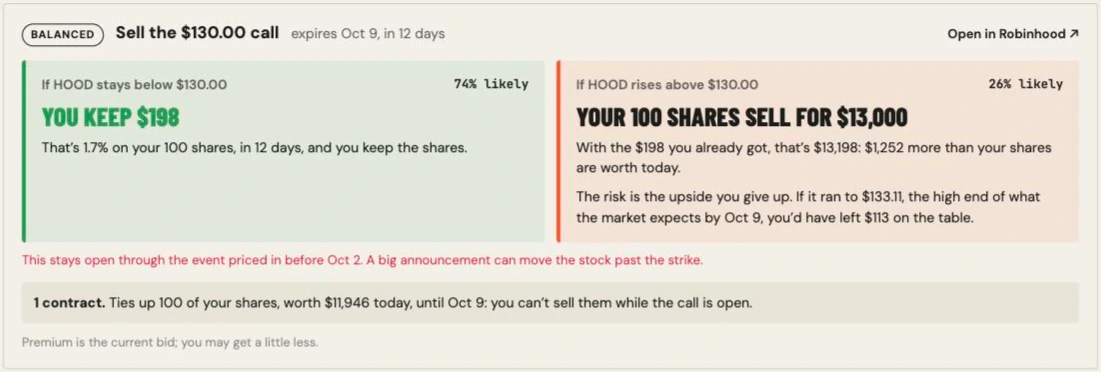
- HOOD stays below $130 (74%): you keep $198 and your shares.
- HOOD rises above $130 (26%): 100 shares would sell for $13,000, or $13,198 with the premium. That’s $1,252 more than they’re worth today, but you give up everything above $130. At $133.11, the top of the expected range, that’s $113 left on the table.
And the Event week $126 call, which expires October 2:
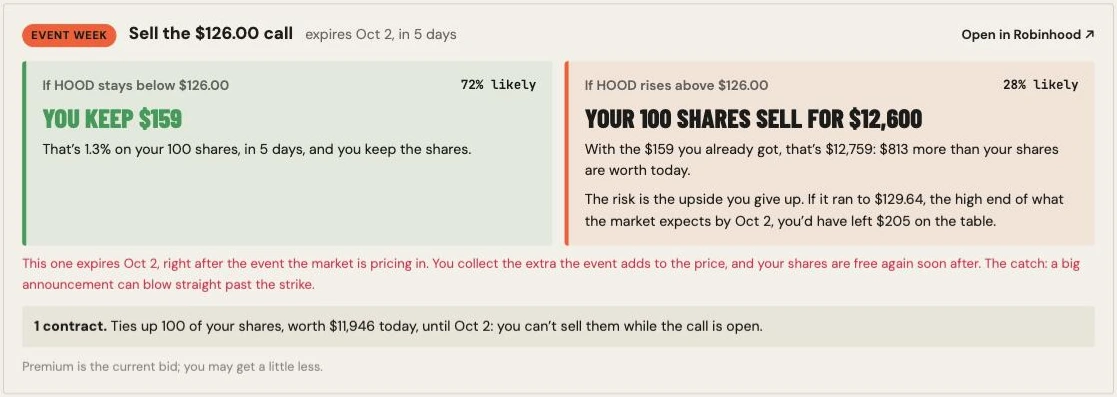
- HOOD stays below $126 (72%): you keep $159, 1.3% in 5 days.
- HOOD rises above $126 (28%): 100 shares would sell for $12,759 with the premium, $813 more than today. At $129.64, the top of the expected range, you’d leave $205 on the table.
Oct 2 or Oct 9?
The Oct 2 call pays more per day because it’s priced for the event, and your shares are free again right after. The risk is a big announcement pushing HOOD past $126 this week.
The Oct 9 calls pay more in total but stay open through the Summit and the week after. A sell-off after the event helps you. A rally hurts you.
The finder won’t tell you which is right. It shows what you’re signing up for either way.
Selling a put instead
If you don’t own the shares, you start by selling a put: getting paid to agree to buy lower. With a $25,000 budget typed in as an example, here’s the $108 put for October 9:
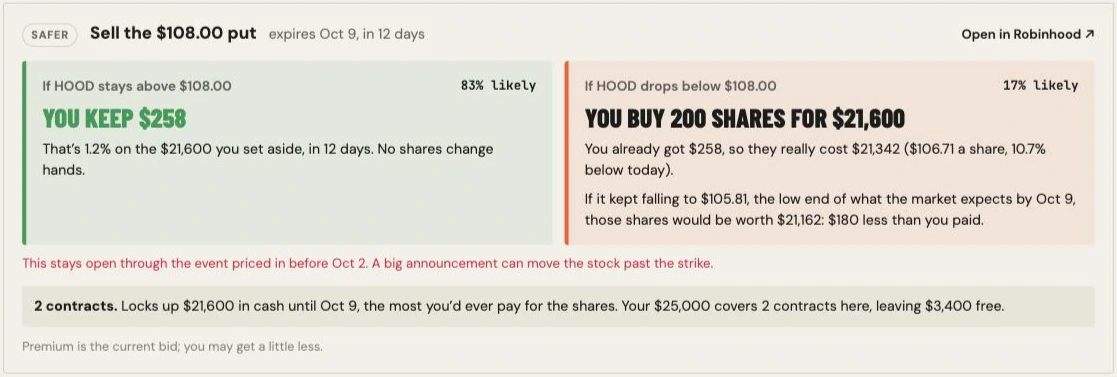
- HOOD stays above $108 (83%): you keep $258.
- HOOD drops below $108 (17%): you buy 200 shares for $21,600, or $106.71 a share after the premium. At $105.81, the bottom of the expected range, you’d be $180 down.
It locks up $21,600 in cash until October 9. The $25,000 covers 2 contracts, with $3,400 left over.
Limits
- It doesn’t read the news. You still have to find out what an event is.
- Prices are the current bid. You may get filled for a little less.
- It can’t place trades. Each idea links to the option chain in Robinhood.
The wheel finder is free. Your positions and quotes go straight from Robinhood to your browser. Only the sign-in and its renewals pass through a small relay on cheapputs.com that stores nothing.
Abrahan, who runs CheapPuts, owns HOOD. This isn’t financial advice or a recommendation to buy or sell anything.